
bialight scaled
Impedance Analysis

Single-Frequency Impedance Analysis

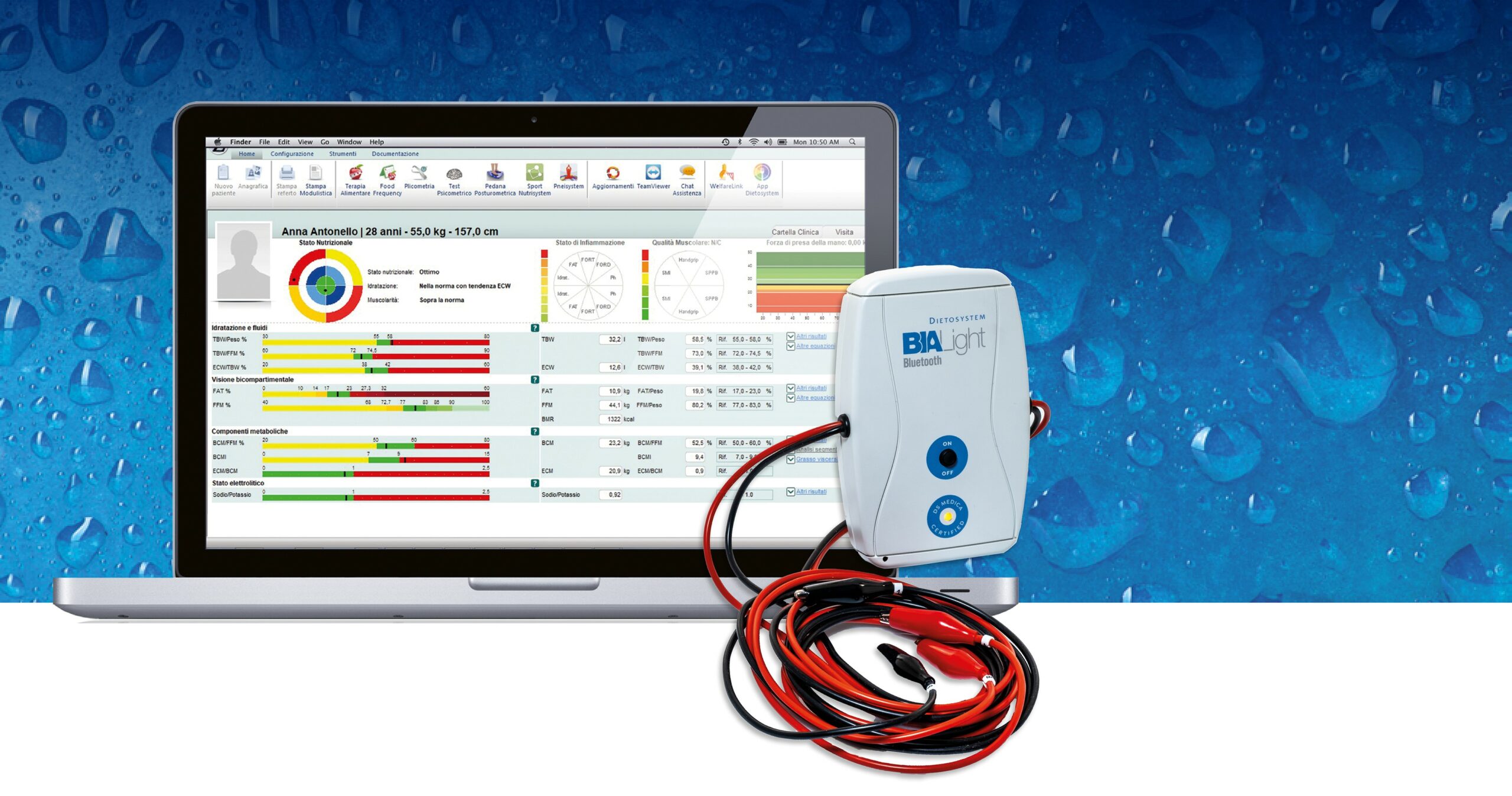
Bialight is the single-frequency impedance analyzer developed by Dietosystem, designed to offer nutrition professionals a reliable and professional tool with a minimal investment.
Bialight combines measurement repeatability, portability, and affordability, making it the ideal solution for clinical and field use.

The precise and repeatable measurement of body impedance and phase angle at the standard frequency of 50 kHz allows accurate assessment of hydration and body composition, through data processing in the Dietosystem Bioelectrical Impedance Analysis software.

The Device: Bialight

Bialight is an ultra-light, compact device, ensuring easy portability.
It connects to the PC via USB cable or Bluetooth, and it is powered directly through the computer, requiring no external power supply.

The instrument performs automatic calibration at startup, ensuring constant measurement accuracy.

Single-Frequency Analysis

The single-frequency mode measures impedance, phase angle, reactance, and resistance at 50 kHz.
Within the software, reference charts have been developed to express the nutritional significance of the impedance data.
These charts help professionals interpret the electrolytic and metabolic status of the patient.

Clinical Record

The software includes a complete clinical record, which, in addition to personal and family anamnesis, allows practitioners to prescribe relevant laboratory tests for evaluating the patient’s nutritional status and record the results.
Out-of-range values are automatically flagged by the software according to official reference ranges.
Users can monitor test results over time and create custom diagnostic protocols.

Developed in collaboration with leading specialists, the software also provides screening questionnaires for gastrointestinal disorders, neurodegenerative diseases, malnutrition, and cardiovascular risk.

Vector Analysis

The vectorial chart provides an immediate qualitative analysis of the patient’s body composition, focusing particularly on hydration status and changes in lean mass.

Vector analysis is based on resistance and reactance normalized for height.
The resulting vector is plotted on a chart containing three population-specific confidence ellipses.
It is possible to compare the patient’s position across the last three visits, enabling ongoing monitoring of nutritional status.

Anthropometric Evaluation

Within the Dietosystem BIA software, users can record skinfold measurements and circumferences to assess body type (biotype) and cardiovascular risk, completing the nutritional evaluation.

The software also allows input and tracking of handgrip strength, measured with a dynamometer.
Combined with validated screening questionnaires, this is particularly useful for assessing sarcopenia risk.

Hydration Analysis

The software automatically selects the most appropriate regression equations, validated by scientific literature, to calculate Total Body Water (TBW) and its distribution into Intracellular Water (ICW) and Extracellular Water (ECW).

Body Composition Analysis

The two-compartment model evaluates Fat Mass (FAT) and Fat-Free Mass (FFM), normalized for height, to provide a more accurate assessment.

The Body Cell Mass (BCM) and Skeletal Muscle Mass (SM) parameters offer detailed insights into the patient’s nutritional and metabolic status.
Visceral fat measurement completes the assessment by indicating cardiometabolic disease risk.

Report

The Dietosystem BIA report can be customized to meet both professional and patient needs.
It can be printed in a summary format or with additional attachments, such as:

  • Explanations of the clinical meaning of each parameter
  • Nutritional status assessment charts

Before printing, users can view a report preview for final review.

Follow-Up

The Dietosystem BIA software allows easy and intuitive patient follow-up through a chronological record of all visit results.
Patient progress is displayed through color-coded graphs representing all key parameters and body composition components.
The history view can be customized by selecting the most relevant charts for each clinical case.

Integration with the Dietosystem Suite

Dietosystem BIA shares its database with the other software applications in the Dietosystem Nutritional Suite, such as Skinfold Thickness Analysis and Dietary Therapy.
This allows real-time data sharing and synchronized updates between applications, ensuring a global diagnostic approach to diet therapy.

Connection with the Dietosystem App

The Dietosystem App allows nutritionists to connect with their patients via a personal access code.
Through the app, professionals can send reports directly to the patient’s smartphone.
Patients can communicate with their nutritionist via a message board and chat, sharing updates and feedback.

This digital tool allows the nutritionist to monitor patient progress efficiently and build long-term patient loyalty.

FAQ

Frequently Asked Questions

Still have questions about the Bialight Bioelectrical Impedance Analyzer?
Check out our FAQ section.

Yes. Bialight can connect to a PC via Bluetooth or USB-A cable.

No. Bialight does not have a built-in display or internal memory. Data are collected directly through the software on the connected PC, which processes and analyzes the parameters.

Yes. Each test requires 4 disposable pre-gelled electrodes, specifically certified for impedance analysis.

No. Bialight does not require scheduled maintenance. It includes an auto-calibration system on power-up.

No. To recharge the device, it must be turned off and connected to the PC via USB cable.

Yes. The test is safe during pregnancy. The software includes a specific predictive equation for this physiological condition.

Scientific literature supports the safe use of BIA in patients with implanted electronic devices (such as pacemakers or defibrillators).
However, it must be done under the supervision of a medical specialist, who evaluates the risk-benefit ratio and monitors the patient during the exam.

For patients with prosthetic implants, it is recommended to perform the test on the limb without the prosthesis.
If not possible, the analysis should be conducted after consulting a medical specialist.

No. Patients can be entered from one month of age, with no upper limit. For pediatric patients, the software uses WHO and Cacciari growth curves, as well as population-specific predictive equations.

Yes. The software can be installed on multiple PCs, but access requires the hardware license key (USB dongle).
To work simultaneously on multiple PCs, additional licenses must be purchased.

Yes. Patient data and test results can be exported to Excel.

No. The software runs locally and does not require internet access, except for downloading updates.

Yes. A client-server network installation can be configured upon request by the central office.

Yes, in full compliance with GDPR regulations.

Yes. Users can independently back up data.
Two restore modes are available:

  • Restore (overwrites existing data)
  • Selective Restore (recovers only selected data, useful for multi-device synchronization)

Yes. Our technical support team is available during office hours, and our nutrition team—composed of dietitians and nutritionists—provides scientific support and software training.
Customers with active updates also have access to detailed video tutorials, live Q&A sessions, and weekly webinars on patient management using the Dietosystem Nutritional Suite.

No. Minor release updates are free through the “Updates” function.
Major releases may involve a fee but are not mandatory.
Previous releases remain functional if system requirements are met.

The Dietosystem BIA software runs on Windows only. For Mac computers, installation is possible using Boot Camp, which allows easy setup of the Windows operating system.

Rectangle 98

Request More Information

Contact us to schedule a personalized presentation of the Dietosystem Bioelectrical Impedance Analysis (BIA) software and receive more information about the Bialight device.
REQUEST INFORMATION